
By Travis Cole
Last updated: October 30, 2026
If your rank tracker says you’re #3 and your phone says #6, neither is necessarily lying. Since late 2025, Google has made it harder, slower and more expensive for any tool to see what searchers see. The data still points the right way. It just can’t tell you your exact address anymore.
Rank tracker accuracy has always had limits, but the last year pushed it further from what real searchers see.
That’s why we tell clients to treat SEO tools like a compass, not a GPS. Here’s what changed, why it changed, and how we read the numbers now.
Why Rank Tracker Results Differ From Google
Rank trackers check Google as an anonymous user from a fixed location and device. You see results shaped by your own location, search history and device. Since 2025, Google has also made results more expensive to collect, hidden where result links point, and started serving fake results to suspected bots.
Even before this year, a few things guaranteed a gap:
- Personalization. Google tailors results by location, history and device. A tracker checks as an anonymous user in a set location, which is rarely what the business owner sees on their own phone.
- Crowded results pages. Map packs, AI Overviews, videos and “People also ask” all push organic listings around. “Position 3” can sit below the fold.
- Zero-click searches. AI Overviews and AI Mode answer more questions without a click, so rankings and traffic drift apart.
- Timing and data centers. A tracker checks once a day, at a set time. Google’s results shift during the day and can differ between its data centers.
- Mobile vs. desktop. Mobile and desktop rankings are often different. A desktop check won’t match what a customer sees on their phone.
- Location precision. For local businesses like movers and HVAC companies, results can change from one zip code to the next. A city-level check can miss what a customer two neighborhoods over sees.
How to check a ranking yourself: Google’s Ad Preview and Diagnosis tool (inside Google Ads) shows a result for a chosen location and device without your personal history. A private browser window helps, but it still uses your real location.
On top of that, three changes since late 2025 made tool data less precise. Here’s each one.
Google’s num=100 Change Made Rank Tracking 10x Pricier
Every rank tracker works the same way underneath: it runs a search and reads the results page. Google has spent the last year making that page harder to get.
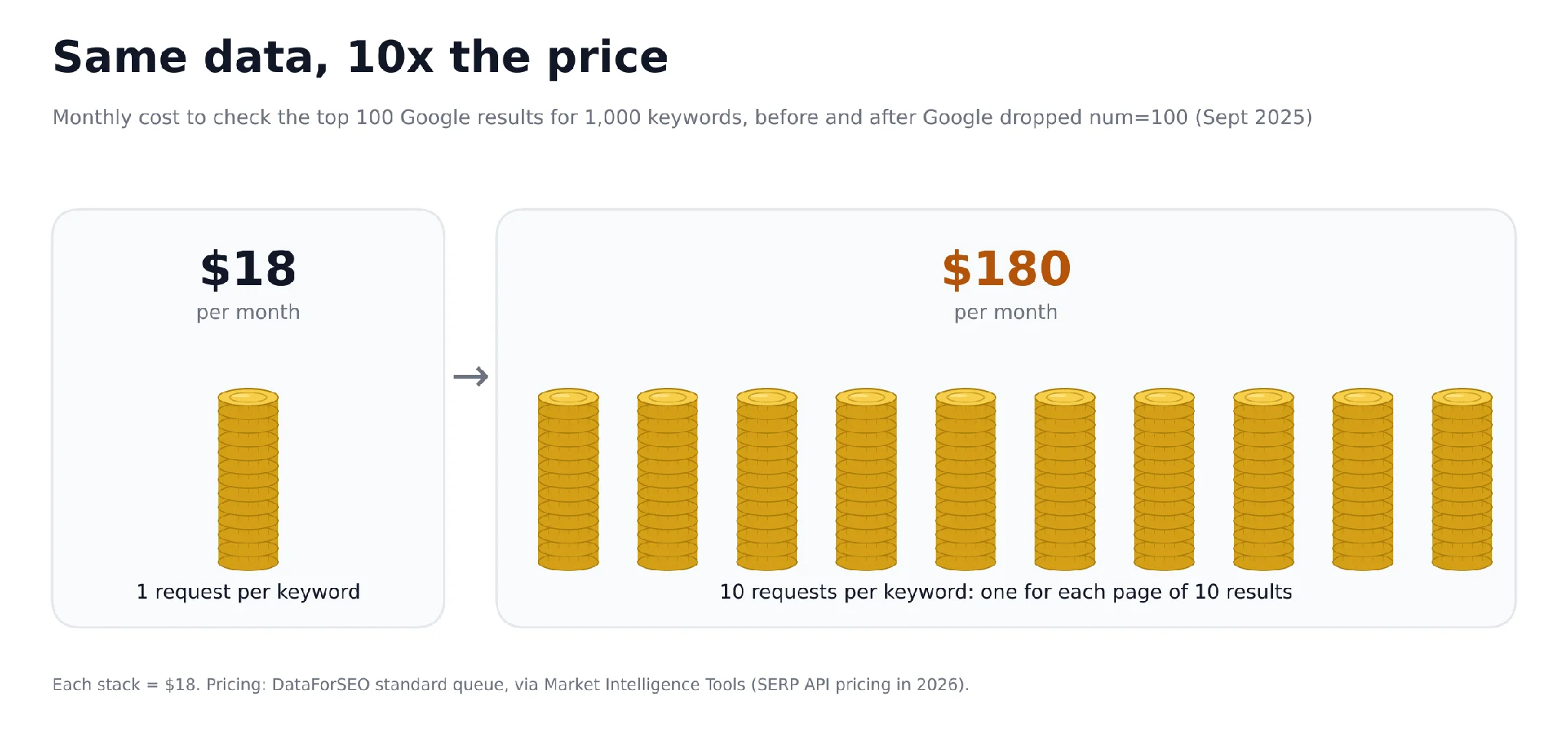
The Google num=100 change (September 2025). For years, adding &num=100 to a search URL returned the top 100 results in one request. Around mid-September 2025, Google stopped honoring it without announcement (Reflect Digital). One request for 100 results became ten requests. Tools that bill per 10-result page passed that straight through: a top-100 check of 1,000 keywords that cost $18 a month on DataForSEO’s standard queue now costs $180 (Market Intelligence Tools).
It also changed Google Search Console. Bots loading 100-result pages had been logging impressions for positions 11 to 100. When that stopped, desktop impressions dropped for most sites around September 10, 2025, while average position appeared to improve (Noble Studios). If a client’s impressions fell that month and clicks held steady, that’s why.
Hidden destination URLs (August 2026). Result links now route through a google.com/goto redirect instead of pointing straight at the page. Nozzle’s CEO measured 500 to 1,000 extra requests per five-page ranking check just to resolve where the links go (Market Intelligence Tools).
Proxy bans and captchas (2025–2026). Google’s SearchGuard JavaScript challenge, launched in January 2025, disrupted essentially every scraper overnight (Proxyway). This fall, wide bans on residential proxy networks and a spike in captchas followed (Relevant Audience).
What that looks like in today’s market, per 1,000 Google result pages:
| Provider | Cost per 1,000 | Note |
|---|---|---|
| DataForSEO (standard queue) | $0.60 | Page of 10 results, up to 5-minute turnaround |
| DataForSEO (live) | $2.00 | Real-time |
| SerpApi (Production plan) | $10.00 | $150 for 15,000 searches a month |
| SerpApi at top-100 depth with AI Overview | $91.70 | Each 10-result page billed separately |
Sources: Market Intelligence Tools, PrismCrawl, cloro, as of October 2026.
Senuto, a large Polish SEO platform, put the trend in starker terms. In 2016 it collected about 1.8 million results an hour for roughly 500 zł a month. Today it manages 120,000 to 200,000 an hour, at more than 100 times the cost per result (Senuto).
The SerpApi Lawsuit: SEO Tools Caught in Google’s Fight With AI
It’s easy to read all this as Google going after SEO tools. The evidence points somewhere else: AI companies that use Google’s results to ground their chatbot answers. Rank trackers collect pages the same way, so they take the hits too.
The clearest example is the SerpApi lawsuit: Google’s case against SerpApi, a Texas company that sells Google results through an API.
- December 19, 2025: Google sued SerpApi in the Northern District of California. It claimed SerpApi broke the DMCA’s anti-circumvention rules by bypassing SearchGuard, and that it sent hundreds of millions of automated searches a day (PPC Land, MediaPost). Google said that volume had grown 25,000% in two years (Bloomberg Law).
- Who the customers were: Reporting from The Information and Sacra put OpenAI among SerpApi’s largest clients, with roughly 40% of its revenue coming from AI startups (Senuto, citing both).
- July 2026: Judge Yvonne Gonzalez Rogers granted SerpApi’s motion to dismiss. She ruled that plain search results, like URLs and snippets, are public facts rather than copyrighted works, and that Google hadn’t shown authority to act for the owners of licensed content it displays (Search Engine Roundtable).
- August 2026: Google filed a narrower amended complaint focused on licensed content such as Knowledge Panel images. SerpApi moved to dismiss again (SerpApi). The case is still open.
The motive is straightforward. Good Google results make ChatGPT’s answers better, and every good answer there is a search that didn’t happen on Google. With the courtroom route stalled, the technical defenses got sharper.
Poisoned SERPs: Google’s Fake Results That Look Real
A block is easy to spot. You get a captcha or an empty page, and you know you have no data. Since September 2026, Google has been doing something harder to catch: poisoned SERPs. Suspected bots get a complete, normal-looking results page filled with the wrong websites.
Nozzle, a US rank-tracking vendor, says these poisoned SERPs started around September 20, peaked near 25% of its results, and have run at 5–11% a day since October 1 (Search Engine Journal). DemandSphere reported about 11% of its daily results affected (Relevant Audience). Senuto found the fake listings often share just one word or number with the query. A search for 20 kg plastic produce crates returned a tram timetable and a robot vacuum, linked only by the number 20 (Senuto).
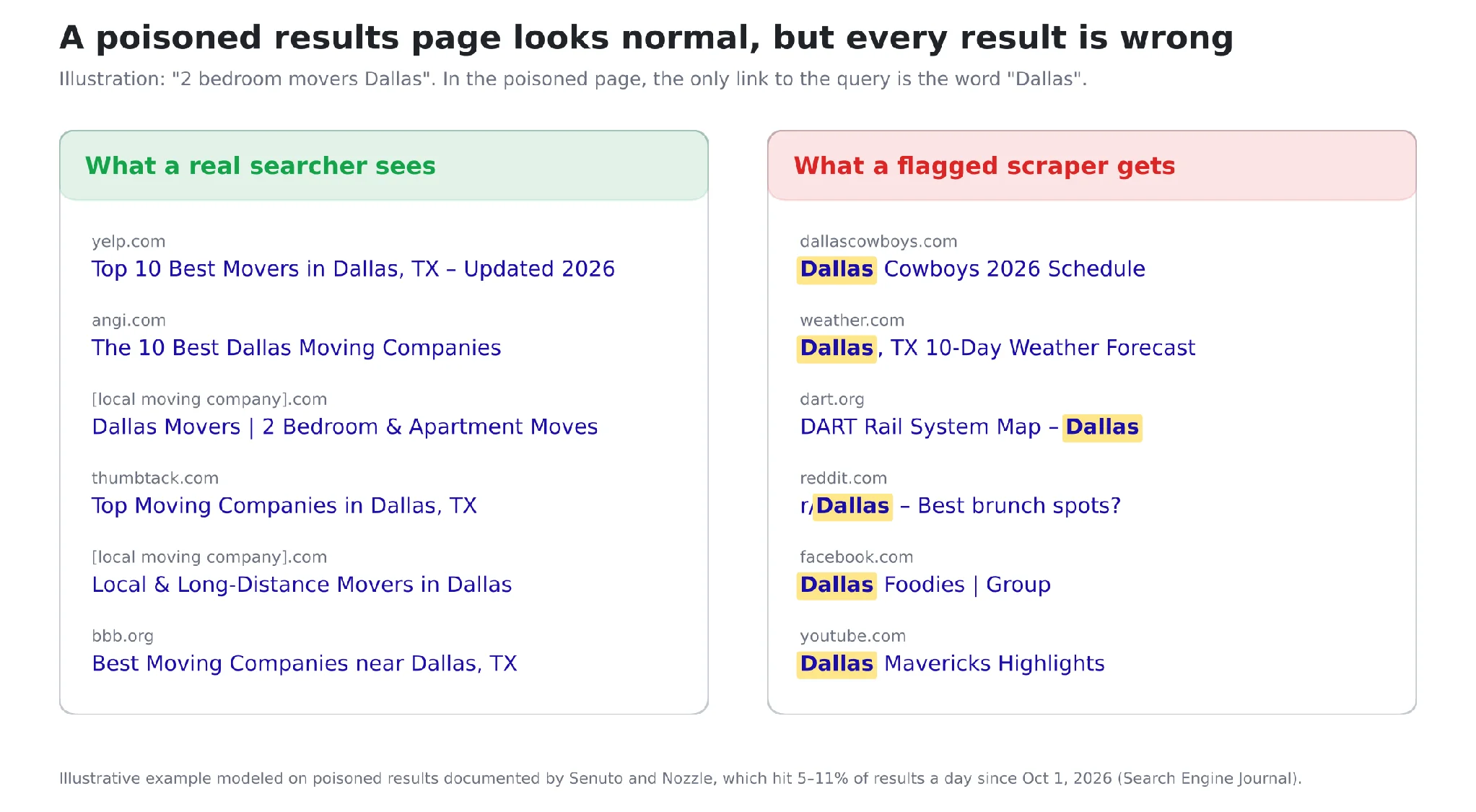
This is worse than a block. A fake result that slips through credits a site with a ranking it doesn’t have, for a keyword it doesn’t target. The good news: poisoning hits individual requests, not keywords, so re-checking usually returns the real page. Serious tools now run relevance checks and re-query anything suspicious.
How to Read SEO Tool Data Now
SEO tool data is directional. It shows whether you’re gaining or losing ground. It can’t promise the exact spot a specific person will see.
Marketers already accept directional data elsewhere. AI visibility tools can’t see every prompt or report search volume, yet teams use them because a trend line beats no line.
So we read the numbers this way:
- Trust trends over single readings. One odd day is noise; three weeks is a signal.
- Check Search Console for traffic and impressions. Use trackers for competitors and keywords you don’t rank for yet.
- Judge success by calls, booked jobs and revenue, not position alone.
What This Means for Rotate Digital Clients
For movers and HVAC companies, rankings were always a means to an end. The end is a ringing phone. That’s why we report on what you can bank: tracked calls, form leads and booked jobs, with rankings as supporting context.
When you see a ranking that doesn’t match your own search, here’s what to expect from us:
- We’ll check it against Search Console and a second data source before calling it a win or a drop.
- We’ll flag tool-wide data problems, like the num=100 change or this fall’s poisoned SERPs, so a reporting glitch isn’t mistaken for a real decline.
- We’ll keep pointing the compass at the same destination: more qualified leads at a lower cost.
The tools aren’t broken. They’ve just stopped pretending to be a GPS.
Rank Tracker Accuracy FAQ
How accurate are rank trackers in 2026?
Rank trackers are directional, not exact. They show whether a site is gaining or losing ground, but the num=100 change, hidden result links, proxy bans and poisoned SERPs have made exact positions less reliable since late 2025. Trust trends over several weeks, not single readings.
Why does my rank tracker show a different position than Google?
A tracker searches as an anonymous user from a fixed location and device. Your own results are personalized by location, search history and device, and they change with time of day and mobile vs. desktop. Map packs and AI Overviews also move organic listings around.
What was the Google num=100 change?
Around mid-September 2025, Google stopped honoring the &num=100 parameter, which had returned the top 100 results in one request. A top-100 check now takes ten requests, which raised costs for SEO tools about tenfold and caused a drop in desktop impressions in Google Search Console.
What is the SerpApi lawsuit about?
In December 2025, Google sued SerpApi, a company that sells Google results through an API, claiming it bypassed Google’s SearchGuard protection. A judge dismissed the case in July 2026, ruling that plain search results are public facts. Google filed a narrower amended complaint in August 2026, and the case is still open.
What are poisoned SERPs?
Poisoned SERPs are normal-looking Google results pages filled with the wrong websites, served to suspected bots since September 2026. Rank-tracking vendors have reported roughly 5–11% of daily results affected. Re-checking usually returns the real page, and serious tools now filter them out.
Sources
- Senuto: W marketingu internetowym zamieniamy GPS na kompas (Damian Sałkowski, Oct 14, 2026)
- Reflect Digital: Google removed &num=100
- Noble Studios: Google retires &num=100
- Market Intelligence Tools: SERP API pricing in 2026
- Market Intelligence Tools: Web scraping pricing in 2026
- PrismCrawl: Best rank tracking APIs in 2026
- cloro: Best SERP APIs 2026
- Proxyway: Search APIs in 2026
- PPC Land: Google sues SerpApi
- Bloomberg Law: Google accuses web-scraping company of copyright violations
- MediaPost: Judge dismisses Google complaint against SerpApi
- Search Engine Roundtable: Google lawsuit against SerpApi dismissed
- SerpApi: Moving to dismiss a second time
- Search Engine Journal: Google is poisoning search results for rank trackers
- Rank trackers are getting poisoned Google results (Relevant Audience)